AI Workspace Broker Software: A Buyer's Guide for UK CRE Brokers
What AI workspace broker software needs to do for UK flex and managed workspace brokers, and where general CRE CRM tools stop short.

Co-founder, Great Space 9 min read
AI workspace broker software is any tool that uses AI to automate part of a broker’s flex or managed workspace deal - most commonly extracting a structured requirement from a client brief, scoring provider fit against it, or assembling provider responses into a comparable shortlist. The category is new enough that most software carrying the label still does one of these jobs. Very little does all three.
That gap matters because the label has started appearing on things that don’t deserve it. A CRM with a chatbot bolted on gets marketed the same way as a platform built around the actual unit of work in this market: a live brief moving between a broker and a shortlist of providers. Worth being specific about the difference before spending a broker’s evaluation time on the wrong category of tool.
What the label covers
Software earns the “AI workspace broker” description by doing one or more of three jobs: brief parsing, fit scoring, and response collation. Brief parsing turns a client’s free-text email into a structured requirement - location, desk count, budget, term, start date. Fit scoring evaluates provider inventory against that structured brief and ranks it by quality of match rather than by whichever providers happen to clear a minimum threshold. Collation takes the responses that come back and puts them into one comparable format instead of a broker manually reformatting six different email replies into a shortlist.
I’ve written a fuller breakdown of how AI is changing the flex workspace broker workflow at these three steps specifically, so I won’t repeat the mechanics here. What matters for evaluating software is that these are distinct capabilities, and a tool can do one well without touching the other two. A brief-parsing add-on for a general CRM is useful. It is not, on its own, AI workspace broker software.
What the label doesn’t cover, whatever the marketing copy implies, is the advisory layer of the job: deciding whether a client needs flex or managed workspace, curating a shortlist down to the two or three options worth a viewing, managing the relationship through to signature. No software claims to automate that, and the ones that come close in tone are worth reading with suspicion.
Where general CRE CRM software stops short
General CRE CRM software stops short at the record type: it is built around a property or lease, not a live requirement broadcast to a shortlist of providers who all need to see the same version of it. Two of the more visible AI launches in commercial real estate this year illustrate the gap well. Buildout launched its CRM component in March 2026, completing what it calls an end-to-end AI-powered deal engine, with agentic AI executing tasks inside the platform rather than just suggesting them. AscendixRE followed in June 2026 with an AI Suite add-on, priced at $39 per month per organisation, that parses email into CRM records, answers natural-language queries against a Salesforce-based CRM, and generates branded comp reports and tour books from live data.
Both are genuine advances, and both are built the same way underneath: around a property or lease record, for leasing and investment brokerage. Neither has an equivalent record type for a live requirement broadcast to a shortlist of providers who each need to see the same version of the brief. A CRM built to track a stacking plan and a lease expiry date doesn’t have anywhere to put a term change that needs to reach five providers simultaneously, because that isn’t the unit of work it was designed around.
A CRM with an AI summary button is a filing cabinet with a torch in it. It helps you read what’s already in there faster. It doesn’t change what’s coming in, or who else needs to see it when it changes.
Of course, a broker running managed workspace deals alongside conventional lettings might reasonably already have Buildout or AscendixRE in place for the leasing side of the book, and adding a second, workspace-specific tool is a real cost worth weighing. But that’s a decision about which tool handles which part of the work, not evidence that one tool can do both jobs. JLL’s 2026 global CRE technology survey, covering over 2,200 C-suite and CRE leaders across 21 countries, found AI piloting jumped from under 5% to 92% of firms in three years, that only 15% have progressed past exploration into actively optimising what they’ve deployed, and that 54% still cite compatibility issues with legacy infrastructure as their top barrier. A lot of what gets marketed as AI-powered this year is still in that gap between piloted and proven.
The three capabilities worth testing
Three things separate AI workspace broker software worth paying for from a demo that doesn’t survive a real brief: how it handles an incomplete requirement, whether its ranking reorders when the inputs change, and whether responses come back in a format a broker can compare without retyping them.
Brief parsing is the easiest to demo and the least differentiating - most general-purpose AI models can extract a desk count and a postcode from an email reasonably well. The harder test is what happens when the brief is incomplete: does the tool flag the gap and prompt for it, or does it guess and pass an unreliable brief downstream as if it were complete?
Fit scoring is where the real difference between tools shows up. Filtering returns every provider that clears a minimum threshold - location, desk range, budget ceiling - without distinguishing a close match from a marginal one. Scoring ranks providers by quality of fit across all those variables at once, and a good implementation folds in provider performance signals too: response rate, whether quoted terms tend to hold, how quickly they typically reply. Ask any vendor demonstrating this feature to show a ranked shortlist next to a filtered one for the same brief. The difference should be obvious within thirty seconds.
Response collation matters more than it sounds like it should, because the alternative is a broker manually copying figures from six different email formats into a spreadsheet before a client can see anything. A tool that returns provider responses in one comparable format - same fields, same layout, side by side - removes an hour of unpaid admin from every brief that gets a healthy response rate.
Take a 15-desk requirement in Shoreditch with a £12,000 monthly budget and an 18-month term. A filter returns every provider with EC2-area stock in roughly that size band, regardless of whether their available inventory is priced at the bottom of the range or the top, or whether their last five responses to similar briefs converted. A scoring model ranks the same providers by fit and by form - live stock at the right desk count, pricing nearer the middle of the stated budget, a response history that suggests they’ll follow through - so the broker’s first look at the shortlist is already close to the shortlist they’d have built by hand after an afternoon of calls.
Questions worth putting to a vendor during a demo: does the tool flag a missing field in a brief, or quietly guess at it? Does a ranked shortlist reorder when you change the budget figure, or does the ranking stay suspiciously static? Can a provider response update the score after the fact, once a clarification question gets answered? A vendor who can’t answer these live, on your own example brief, is describing a roadmap rather than a product.
What good AI workspace broker software shouldn’t do
Good AI workspace broker software ranks and shows its reasoning; it doesn’t decide on the broker’s behalf. A tool that auto-selects which provider quotes reach the client, rather than surfacing a ranked shortlist for the broker to choose from, has removed the part of the job that needs a broker. Curation - knowing which provider negotiates badly after a smooth proposal, which building photographs better than it presents, which client will take a serviced office seriously versus a coworking membership - depends on context no scoring model holds.
There’s a trust dimension here too, not just a competence one. Software that scores a shortlist and shows its working, why this provider ranked above that one, earns a broker’s confidence over time.
Software that decides and stays quiet about the reasoning gets used once, distrusted after the first match that misses something obvious, and quietly abandoned.
JLL’s own survey found most firms are still in the exploration phase rather than full deployment. A black-box decision layer is exactly the kind of feature that erodes the trust adoption depends on, before the category has even had time to prove itself.
What Great Space does differently
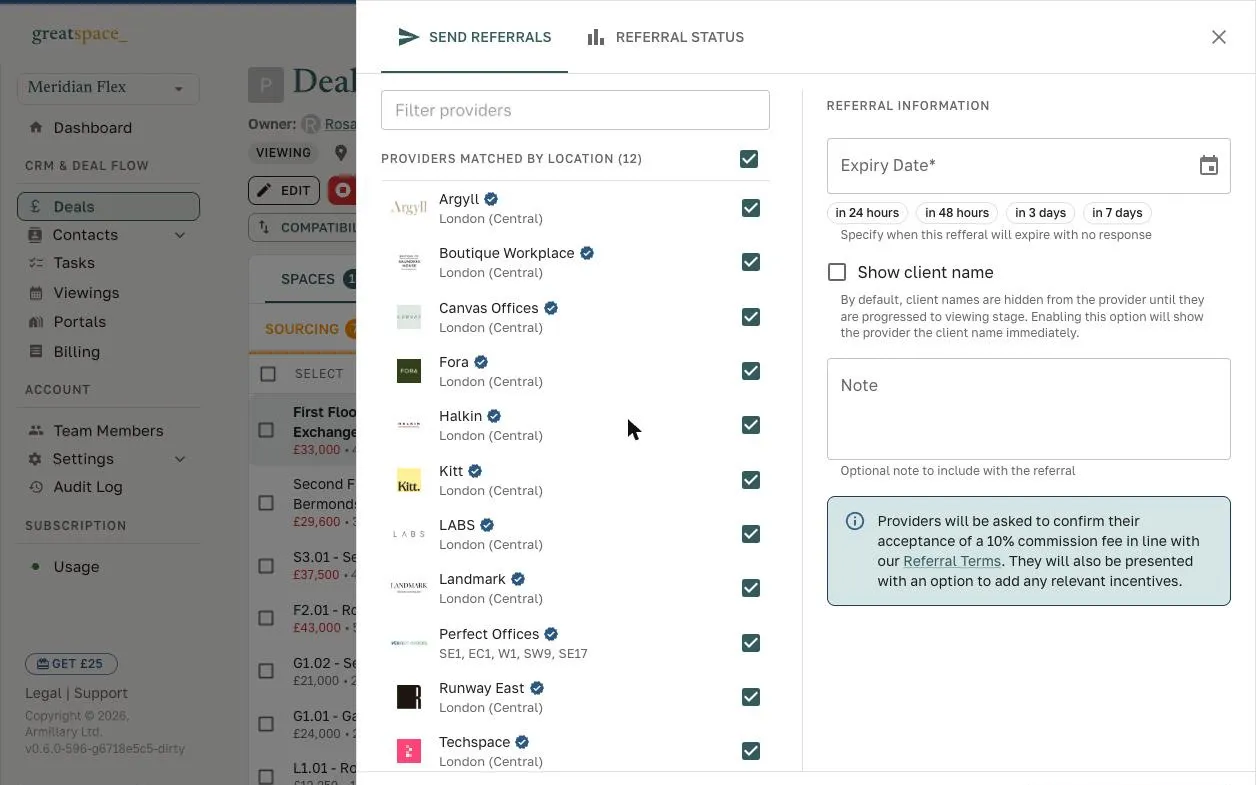
One brief, every matching provider
Location, size, budget and term go to every verified provider with matching space, not the five you remember to email.
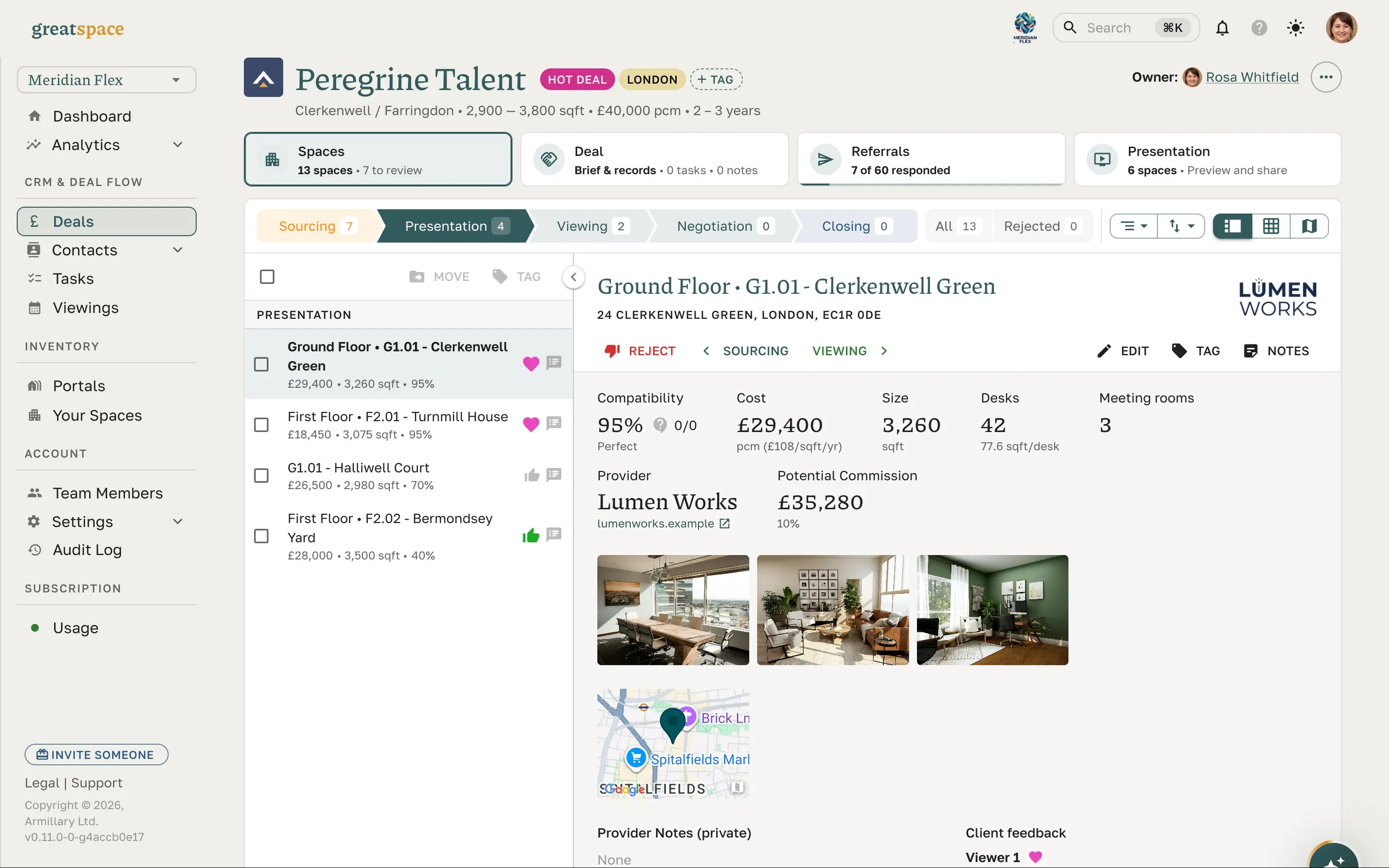
Responses, ranked against the brief
Each space arrives scored on location, size, budget and term, with its cost and your potential commission alongside.

A client presentation in seconds
Pick the spaces and your client gets a branded presentation to love, like or pass on, with a viewing day planned around their favourites.
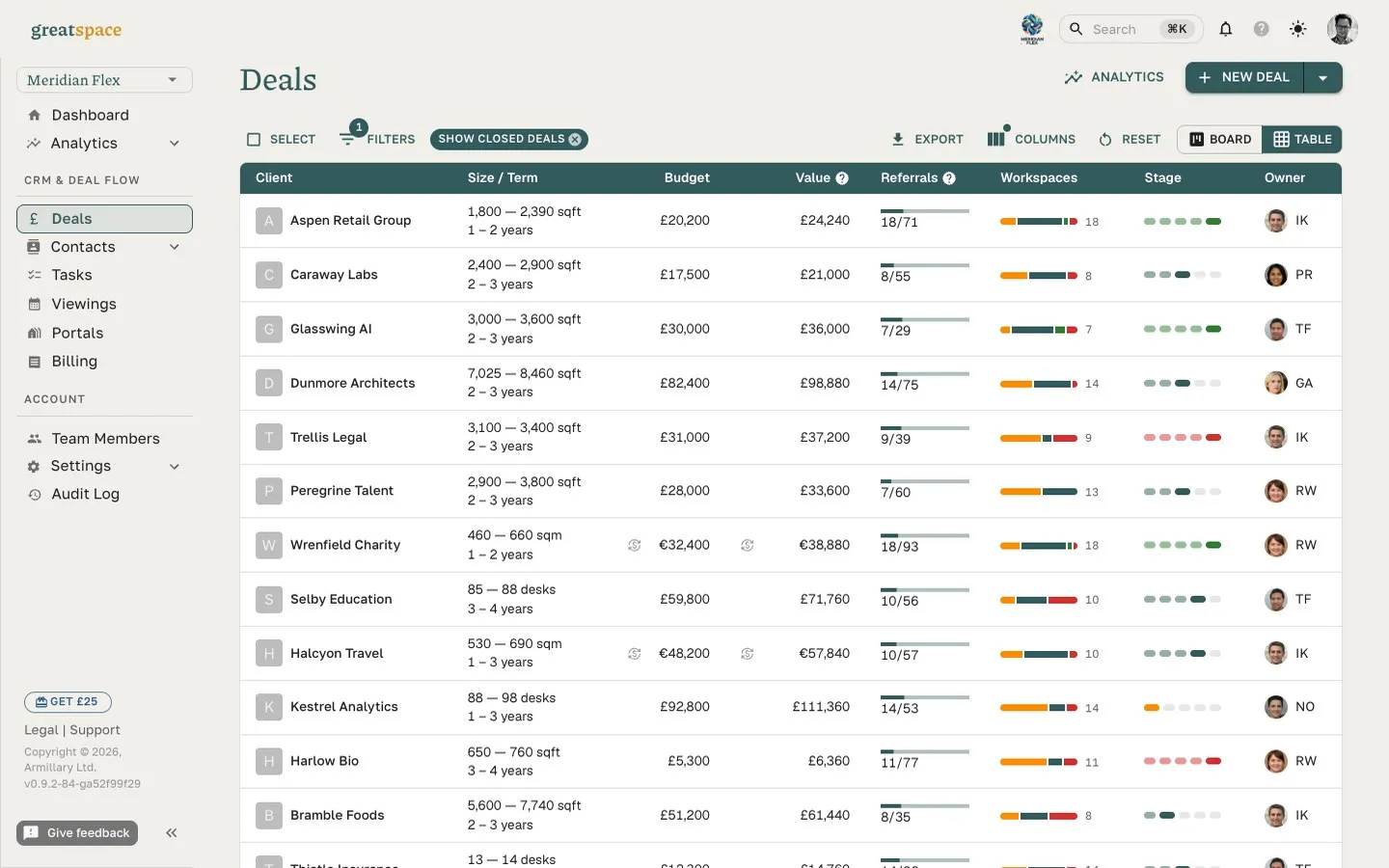
Every deal, through to close
Sourcing, viewing, negotiation and closing in one pipeline, so you always know which deal needs you next.
On the Great Space platform, every provider response is scored against the client’s requirement and ranked automatically, but the broker sees the ranking and the reasoning behind it, not just a final pick. When a provider’s response has a gap against the brief, the platform sends a targeted clarification question rather than guessing, and the answer feeds straight back into re-scoring. Brokers who want to go further can set a compatibility threshold on a deal and let weak matches auto-reject, with the option to reverse that automatically if a provider closes the gap through clarification.
None of this replaces the broker’s shortlist. It narrows the pool the broker is choosing from down to the providers worth their attention, drawn from a network of 190+ verified UK providers covering both flex and managed workspace. For brokers whose current workflow is built around email distribution and a personal spreadsheet rather than a structured brief, the difference shows up first in how much of a working day goes to reformatting responses rather than reviewing them - and for the wider context on why 2026 has been a volatile year for AI claims in commercial real estate, see how AI is changing commercial real estate in the UK.
If you’re evaluating AI workspace broker software for a UK flex or managed workspace desk, start free on Great Space. No credit card required, and providers always receive and respond to referrals for free.
Written by
Chris TingleyCo-founder, Great Space
Chris Tingley is co-founder of Great Space, the workspace deal platform for UK CRE brokers — building tools for flex and managed workspace brokers and providers.
FAQ
Frequently asked questions
What is AI workspace broker software?
AI workspace broker software is any tool that uses AI to automate part of a flex or managed workspace deal - most commonly extracting a structured requirement from a client brief, scoring provider fit against it, or assembling provider responses into a comparable shortlist. Most software carrying the label still does one of these jobs, not all three.
What software do workspace brokers use to manage deals?
Most UK flex and managed workspace brokers still run deals through email, a personal spreadsheet, and general listings platforms - there is no dominant purpose-built tool for this market. A smaller group has adapted commercial real estate CRM software built for leasing and investment brokerage. Purpose-built platforms like Great Space are a third, newer category, built around the referral rather than the property record.
Best tools for CRE brokers handling flexible office space?
General CRE CRM tools - Buildout, AscendixRE, Apto, RealNex - are built around a property or listing record, which suits leasing and investment brokers well. Brokers handling flex or managed workspace requirements are better served by a platform built around the brief itself: a live requirement scored against provider inventory and pushed to a shortlist, not a record searched and updated by hand.
How is AI workspace broker software different from a general CRE CRM?
A general CRE CRM's AI features - document parsing, natural-language record search, comp report generation - sit on top of a database of properties and leases. AI workspace broker software sits on top of a two-sided referral: it scores a live brief against provider inventory and structures the responses that come back, which a leasing-focused CRM has no equivalent record type for.
What should AI workspace broker software do?
Three things, at minimum: turn a free-text client brief into a structured requirement (location, desk count, budget, term, start date); score provider inventory against that requirement rather than just filtering by minimum thresholds; and return provider responses in a comparable format the broker can shortlist from without manual reformatting.
Does Great Space use AI in its broker software?
Yes. Every provider response on Great Space is scored against the client's requirement and ranked automatically. Gaps against the brief trigger targeted clarification questions rather than a guess, and a broker can set a compatibility threshold to auto-filter weak matches. The network covers 190+ verified UK providers across flex and managed workspace.
Open Plan
Enjoying Open Plan?
Get the next issue in your inbox.
Commission benchmarks, deal intelligence, and provider data for workspace brokers.
Check your inbox — we've sent you a link to confirm your subscription. Check your spam or junk folders if you can't find it.
No spam. Unsubscribe anytime.
More from Open Plan
Managed Workspace Broker London: What Providers Need to See Before They'll Quote
How London managed workspace providers assess a broker brief, why submarket detail matters more here than in flex, and what actually gets a quote back fast.
How to Track a Flex Workspace Broker Pipeline Without Losing Deals
How UK brokers should track a flex and managed workspace pipeline: the stages worth tracking, why spreadsheets break, and what operators see when they don't.
The UK Flex and Managed Workspace Market: 2026 Broker Report
UK flex and managed workspace market data for 2026: verified supply, pricing, and demand figures, plus what Great Space's own broker deal flow shows.
Ready to manage your flex workspace deals in one place?
Source, shortlist, present, and close — with commission tracked end to end. Free to start.